
Are There Enough Troops?
Maximizing Societal Mobilization

Consider three pieces of information:
1 conscript can be recruited and trained per 10 peasant families.
The average wage of a soldier in ACKS is about 25gp, for a normal agrarian society.
The expected garrison has wages of 2gp per family in civilized territory, 3gp in borderlands, or 4gp in outlands.
1 conscript per 10 families, at an average 25gp wage, works out to 2.5gp per family. From this, we can naturally conclude that at least half of the population in a society following the typical structure must live in civilized domains, or else the society will be unable to meet the expected garrison expenditure without a militia or an outside source of troops (neither of which the Auran Empire or other “default” societies seem to rely upon).
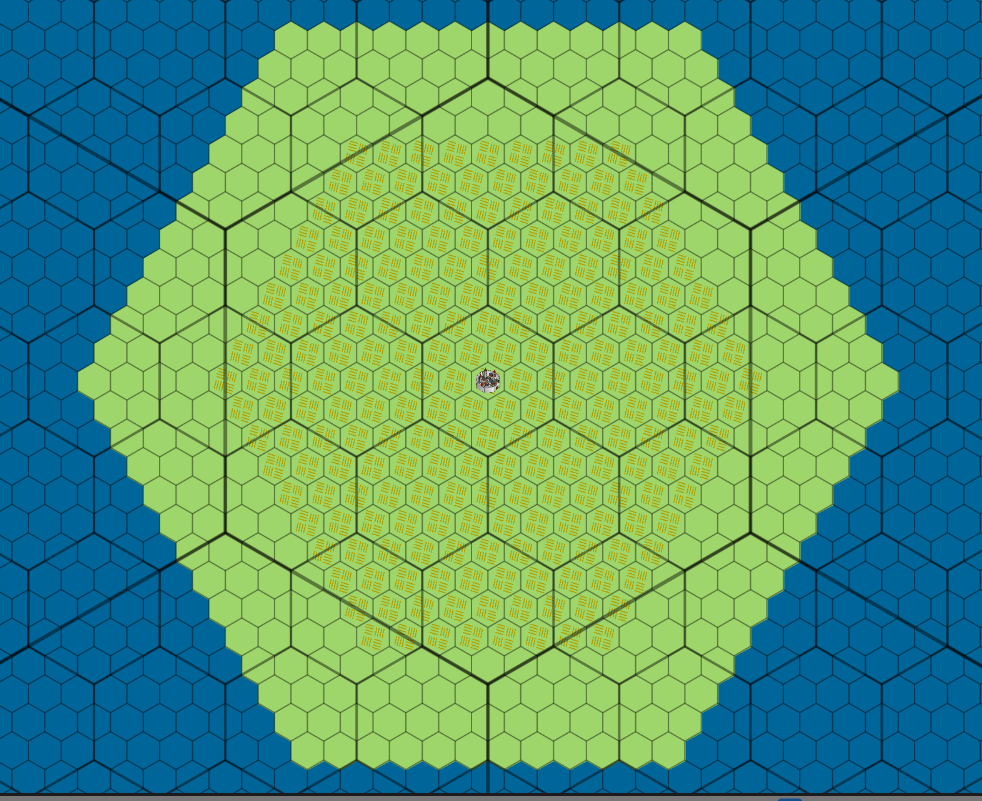
Half-civilized is not a hard target to meet, but does suggest non-homogenous population densities. A large town or city automatically civilizes all domains within 48 miles (208 6-mile hexes), plus improves the next 24 mile radius around that to borderlands (a further 252 hexes). Given that the maximum population density in civilized territory is twice that in borderlands, it seems reasonable to assume the actual population densities follow the same pattern (with outlands naturally having half the density of borderlands, to match).
Tangentially, 125/250/500 peasant families per hex in outlands/borderlands/civilized is a good baseline I’ve found useful for big picture mapping — notably, it was the default applied for my ongoing patron wargame in Mythic Greece, and yielded reasonably historical values. If mapping down to individual 6-mile hexes in detail, with patches of unsettled land amidst inhabited country where there are old forests, uncleared swamps, and the like, it works elegantly when increased to a denser 160/320/640 peasant families per hex because that lines up with the typical populations given for the personal domain of a barony (160 families on average) or march (average 320 families) so that they fill neat whole, half, or at least quarter hexes.
Above, I offered without justification an average wage of 25gp per troop. I don’t think that value is made explicit within the books, it’s just a number I’ve gotten from Alexander Macris, which I trust and which does seem to line up with a lot of historical distributions. But it does raise the question, what is the maximum average wage per troop? In the trivial case, you only train cataphracts, and it’s 87.5gp (because 25% of troops are veterans at steady state). In the more interesting case where every conscript is trained into the highest wage troop type they qualify, a spreadsheet is called for, which yields an average wage of 28.56gp/troop.
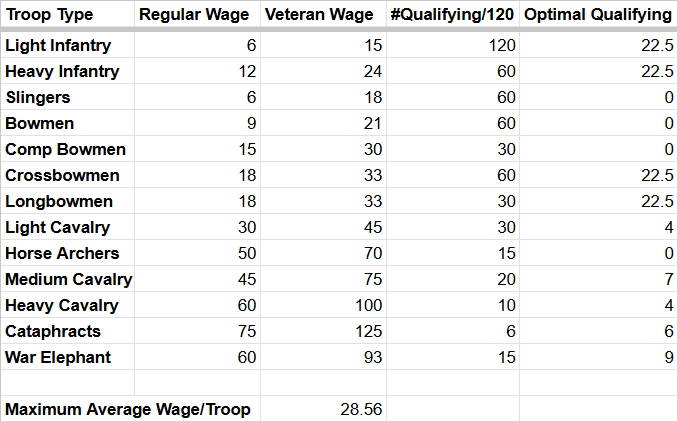
The assumed default and historical norm of 25gp/troop monthly wage thus appears pretty close to an optimal configuration, and we are further justified in expecting realms to concentrate most population in civilized areas.
Alternative Solutions
What if we have a society that isn’t mostly civilized, but has lots of Borderlands and Outlands regions, how can that be made functional?
ACKS presents five main options. First, it can call up a militia, or more likely have a trained militia. That as much as triples the recruiting pool, though with penalties to domain income and morale while it is mustered. (A trained militia counts against garrison cost regardless of whether it is mustered, however, so it makes a convenient solution.) This is the solution applied to demihumans, whose realms are typically fractured and broken and do not benefit from optimally placed large settlements.
Second, the domain can be a Clanhold. Clanholds have no large settlements, and never improve beyond Outlands, but every man is a warrior and every family contributes such a man. This is a tenfold increase in the recruiting pool, and they all come trained and ready to fight, but removes the ability to develop large settlements or use complex favors and duties. This is the solution applied to low density “barbarian” societies, such as Viking-esque raiders, pastoralists, and hunter-gatherers. In variant form, it also serves for the nomad demchi rules.
Third, the domain can use the rules developed for Republican City-States (on the Patreon and eventually Axioms), in which slave gangs are given to freeholding families to free up additional manpower to join the aristocratic soldier elite. This is costly in terms of domain income, but provides permanent soldiery compatible with civilized domains and large urban centers (though I would recommend not adding many more citizen-held slaves than necessary for the desired force size, because they do get very expensive).
Republican City-States are particularly useful in the historically common case where you have a large imperial power base with a preferred soldier pool that is only a small subset of that. Historically this tends to arise because the Delian League wants to field Athenian soldiers rather than Greek soldiers, or the Ptolemies prefer ethnic Macedonian soldiers to Egyptians, or the Roman Republic wants Romans and Socii from Italy rather than levies from the early provinces. By granting citizen-held slaves, that large tributary base can be translated into troops of the specific preferred varieties.
If a Judge wanted to introduce this sort of framework in their game on a mechanical basis, giving every ethnicity Inhumanity with all other ethnicities would force a substantial shift in that vein (by imposing a penalty to reactions, loyalty, and morale with troops from other cultural bases; for a softer version, apply this only with 0th level characters and assume levelled leaders are more neutral-minded unless specifically specified otherwise). ACKS reasonably avoids this as part of its default paradigm of taking Antiquity at its best to dampen the rampant, overt discrimination of that era, so Republican City-States in turn seem substantially less necessary because the world is more enlightened and cosmopolitan.
Fourth, the garrison can be supplemented with trained animals. “Garrison cost cannot be paid with expenditure on henchman, mercenary officers, specialists, or any other hireling except actual troops”, but at the least we do know that cavalry and war elephants count, so I could see permitting a reasonable number of guard dogs to be used in similar fashion to supplement a garrison (applying their rental rate as effective garrison wages). This has upsides and downsides; notably, it’s a lot easier to compromise or bribe away a relatively smaller group of elite animal handlers, who will naturally comprise a concentrated power block within the military.
Fifth, and finally, the domain can recruit from abroad to gain outside sources of soldiery. This obviously doesn’t work in a vacuum where such resources are not available, so it can’t solve issues at the level of a setting as a whole, but if there’s a particular frontier or war-torn region, it can increase its ability to field troops via foreign mercenaries, Call to Arms favors from vassals elsewhere, slave soldiers, etc.
Conclusions
There are indeed enough troops! And when there aren’t, the various methods for solving that seem to have a reasonable set of tradeoffs against one another. Mixing different options in a campaign map adds interesting cultural differences to mobilization, especially when some polities also have senates, some are oligarchic, etc. — you get a lot of diverse approaches to warfare incentivized directly from the basic building blocks of society, even before you get into different societies having different compositions of troop types. At some point I would like to build a set of more focused mercenary recruitment tables to reflect that as well, and perhaps rules for abstract mercenary companies . . . but for now, this shall be plenty sufficient.
Nicely put. When I ran the numbers for Albion, I assumed average Borderlands and a militia componsed exclusively of infantry (no crossbows, either), and wound up needing foreign mercenaries. I think the result of "civilized borderlands" (and outlands) needing to either have recruits from an imperial core or from a neighboring clanhold is nicely historical.