
On Alignment
The Distinctives of Alignment as Allegiance

When I started this blog, my chief aims were to provide a centralized, shareable record of resources I’ve made, and to work out answers to common questions and starting places for recurring discussions, so that instead of repeating the same old arguments we might at least elevate the starting place and reach new arguments. To that end, the question of alignment has long gone untouched, and is worth addressing.
To be clear, this is not a general history of alignment as a mechanic; that has been provided elsewhere with great thoroughness. Likewise, this certainly doesn’t settle the debate; there are infinite objections. I would like to progress the debate to deeper and more nuanced topics, rather than the standard routine I am guilty of promulgating.
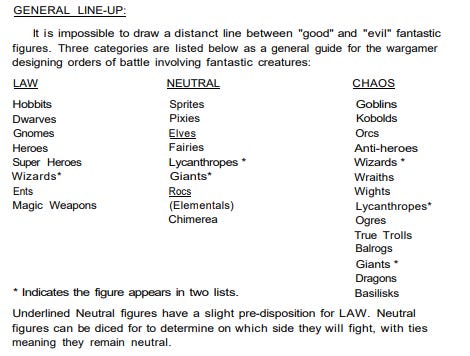
Specifically, I am focused on the usage of alignment in ACKS, which frames it along a single axis of cosmic war between the forces of Law and Chaos — “Alignment as Allegiance.” But it is not the Law and Chaos of Moorcock’s Elric, wherein both are dangerous extremes, and humanity must seek Neutrality and balance in between them. Rather, the vision of Poul Anderson prevails as in Three Hearts and Three Lions — Law as light and reason and justice and civilization, enlightened law in the Classical sense, standing opposed to the darkness and despair of Chaos, which envelops both tyranny and anarchy, those extremes in which men are subjected to arbitrary and capricious rule, where might makes right, the strong do what they can, and the weak suffer as they must.
While there is certainly contemporary usage of Chaos (and Chaotic Good / Neutral / Evil) alignments with reference to whimsy, spontaneity, quirkiness, classical liberty, and anti-authoritarian sentiments, that is simply not what is being referred to in this context. Enlightened Law secures and protects liberty, tyranny is essentially Chaotic, and character quirks (while often annoying) are largely irrelevant to matters of alignment.
Alignment as Morality?
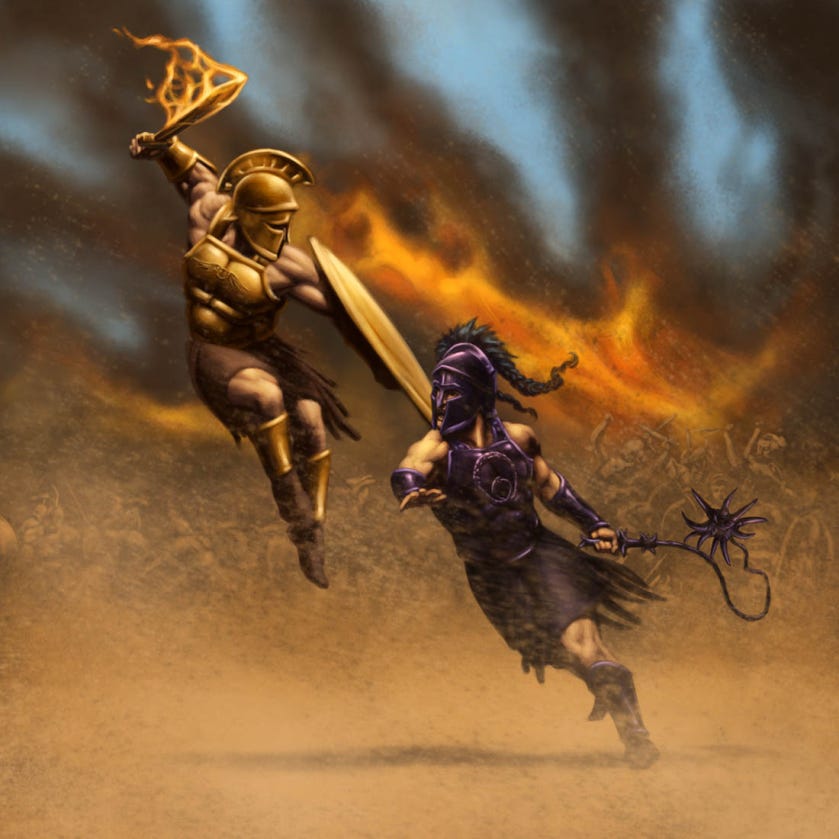
Law versus Chaos is a clear dichotomy in such works. However, that same juxtaposition starts to overload alignment with a lot of morality-laden meaning. And I do think alignment has moral implications for characters, but morality is not the core function thereof. The point of such alignment is rooted in its original role in traditional wargames — establishing the teams, the sides in the focal conflict, the broad factions that actors are sorted into.
Consider the case of World War II: the two alignments are clearly the Allies and the Axis. Without getting into an argument over the details, I think we can broadly claim that the Allies had more concern for moral action and are unambiguously “the good guys”, to the Axis “bad guys”. That said, if we want to consider whether assassination, torture, bombing of civilians, etc. are Allied or Axis tools, they are clearly used by both. There is a moral inclination, but the hard line between the Axis and the Allies is not one of morality.
What is the hard line, the actions that inherently place you as a member of one side or the other? Allegiance to a side and fighting for its cause. If you’re a saboteur and assassin, that doesn’t inherently align you; what aligns you is the side you fight for. If you’re an Allied soldier who fights the Axis, you’re one of the Allies, and vice versa. Likewise, when has someone crossed a line, such that they have switched alignment and are no longer an Ally? They have done so at the point that they’re no longer fighting for the Allies, and are either a self-interested mercenary or non-combatant (Neutral) or have joined the Axis.
To be clear, that’s not to say that everything the Allies did was Good; in point of fact, calling their alignment “the Allies” rather than “Good” specifically avoids that. By choosing in-setting names for the factions rather than ones which impose a direct moral judgement, we avoid a messy argument about morality, in favor of leaning into the premise of setting the game in World War II. (And if players want to argue about morality, they are welcome to, but the game rules don’t depend upon it.)
Essential Myths
We can see the same dynamic at play in Star Wars. The Empire is the Bad Guys, and the Rebels are the Good Guys. That doesn’t stop the Rebels from doing morally-questionable things at times, but we have a very clear alignment framework that persists regardless of such actions. Likewise, Saw Gerrera’s disregard for many of the principles of the Rebellion doesn’t introduce particular ambiguity into the fact that he is a member of the Rebellion and fighting for the Rebels, against the Empire. And when Han heroically returns to save the day at the end of A New Hope, even if he has just converted from Neutrality to Law, he’s still a scoundrel who’d cheat at cards.
How does all this apply to fantasy? Well, if we look to mythology, Law and Chaos is a very fundamental divide across cultures around Europe and the Mediterranean (i.e. the sphere of Classical Antiquity). The Greek Gods against the Titans, the Norse Aesir against the Giants, Celtic Tuatha De Danann against the Formorians, Babylonian Marduk against Tiamat, the Egyptian Ennead against Apophis. This axis seems broadly present across many cultures as a major metaphysical divide, and carried forward across speculative fiction (e.g. E.E. “Doc” Smith, Poul Anderson, Roger Zelazny). It doesn’t mean that Zeus, Odin, Corwin, and the rest are always Good, but they’re pretty clearly on the side of Law.
What About Internal Conflict?
Alignment as Allegiance also doesn’t preclude internal conflict within a side. Soviet meddling in Poland and British hesitance to reopen the Western Front can still drive tensions, and potentially such powers could end up fighting one another as well, but it is not the focal conflict of such a setting, and obviously harms the cause of the Allies as a whole. Similarly, internal conflict between Vader and Tarkin is practically a given in Star Wars. It’s reasonable to ask then, if the sides can be fluid or irregular, what’s the point of alignment? And the answer is that alignment is normative.
If I build a WWII wargame, and on turn two Britain sells out to join the Axis and divvy up France between them to secure peace in Europe while Russia joins with Japan to invade the western United States . . . that might be interesting, but it has fundamentally failed as a WWII wargame. Likewise, Lawful crusaders and Chaotic orcs are on opposite teams and shouldn’t generally be cooperating, because otherwise you miss the desired focal conflicts of adventure and war and conquest. Maybe they team up momentarily because the orcs are subject to a (Chaotic) wyrm, and both want to see it dead, but even that should be fraught with fear of treachery because fundamentally they are not on compatible sides and the power balance between their sides in the long term is zero sum.
So What’s the Point?
What practical utility does that mechanic offer?
First, inasmuch as it has accepted normative power, it sets expectations and creates patterns of behavior. Consider: there’s no rules that force players to seek XP, and games do exist (such as Traveller) where there is no such mechanic. But it’s part of the game’s normative framework that seeking XP is what characters do, and a core premise of gameplay. Alignment likewise establishes a normative premise of what the teams are, who can work together with whom, what basic standards of morality are “normal” for each side (and what consequences you might expect for violating such norms). Contrary to typical thought, I find that examination of normal play suggests it is basically effective in that respect. Players understand the sides, and generally abide by that well.
On a more concrete level, team-setting can be encoded in mechanics that reinforce the distinction. There are modifiers to reaction rolls, domain morale, and vassal loyalty based on alignment. Some spells and abilities have effects determined by alignment (e.g. holy circle, or a Paladin’s Aura of Protection). Armies broadly won’t be composed of both Lawful and Chaotic troops. Different spheres can respond differently to different alignments, magical Corruption pushes characters toward Chaos, and many creatures are innately aligned (e.g. angels, demons).
Moreover, teams have different “special abilities.” Chaos can perform blood sacrifice and necromancy, has lots of options for irregular and monstrous troops (e.g. beastmen, giants, undead), and can feed them prisoners. Law tends to have larger, more stable realms that can reliably generate competent officers and disciplined (Formed/Loose) troops (not strictly exclusive but it often tends such). Some particular monsters (like faravahar, khepri, lamias, or the easily-summoned and fantastically-potent phoenix) can have a notable impact on their own in like fashion.
Last, on an aesthetic level, I have observed it to help shift players from their present mindset into something truer to Antiquity — not an age where peace fosters prosperity, but one of conquest and heroics. Some may consider that ill, but I appreciate it, for supporting the intended gameplay as heroes akin to those of Antiquity.
That sort of “moral confusion” is arguably the greatest flaw of such a paradigm, but it seems largely nonexclusive. Few enough reasonable, intelligent people can agree on moral frameworks for it to be solved in a tabletop roleplaying game! I would rather explore those alternate moral frameworks, and see theirs flaws from within as one who has for a time embraced them, than to refuse them (an approach, I might note, which is already necessary if one intends to play more than one alignment). Playing Chaos, after all, has often revealed the superiority of Law in many respects taken for granted — institutional support, structural cohesion, loyalty of henchmen and vassals.
Where From Here?
I think this is an appropriate schematic overview of the position, but some notable points remain worth dealing with. The perennial debate about orcs and goblins, free will, biological imperatives, cosmic imperatives, and the divine is an important one that I do intend to review but need to review past discussions of first, and will probably be of some length of its own.
Some thoughts on the role of fantasy religion more generally also seem worth developing. Religion is omnipresent in Antiquity, and it would be difficult for a setting to overstate its role (albeit easy to miss its focus). I’ve fleshed this out with some mechanical frameworks for playtesting previously but there’s a lot of room for setting-level elements rather than just rules. Pedantic Demography recently published Alternatives to Aslan on a related topic. Perhaps the eventual solution here is to publish a section of the my Frozen North or Madran League or some such, that’s just tricky when I have players actively adventuring in those regions and would rather not give away my secrets.
The classic argument about “Lawful Stupid” and paladins falling from grace, on the other hand, I think is largely headed off by Alignment as Allegiance as a model. Setting aside the above concern over the innate Chaotic alignment of orcs and such, killing orc-spawn is unambiguously Lawful — it destroys a Chaotic force in the making. Law does not mandate particular actions, though it may proscribe some options (e.g. necromantic buffs, poison) that might otherwise be useful.
Can Law and Chaos adventure together? I am inclined toward yes-with-caveats, but will think on it further to lay those out clearly. Chaotic characters in a Lawful society (or vice versa) will naturally want to keep their beliefs secret to avoid being tried and executed for heresy, so this comes up more in the context of “can I cooperate temporarily with the monsters?”
Are there other big questions on alignment worth giving some thought to? Let me know!
Probably the biggest confusion I see, other than the good/evil that you addressed, is chaos as random/silly.
That is a whole topic. I see a lot of players, especially thieves, who claim chaotic alignment because they want to be silly. It gets reinforced by the DND memes and nine-grid alignment chart jokes where chaotic neutral is always some version of a clown/joker.