
Regency and Magic
Spellcasting and Expanded Magic Research for ACKS Birthright

The most iconic option available to blooded spellcasters is realm magic, but a number of additional options exist to support and enable such grand feats, and some general adjustments can be made to spellcasting to better support such a milieu.
Magic Types in Birthright
One of Birthright’s traditional quirks was that non-blooded arcane spellcasters were limited in various ways as mere “Magicians” with no innate magical abilities, and full arcane magic was only available to blooded Wizards. ACKS has a system that reflects such distinctions quite neatly, in my opinion, and can easily be extended to fold in divine casters as well: namely, ceremonial magic. Blooded spellcasters may be either mages or any of the standard divine classes, and use spell slots as normal. Non-blooded spellcasters use ceremonial eldritch classes. This distinction also helps keep non-blooded spellcasters relevant while leaving them broadly inferior: they have more breadth individually, and the quirks of ceremonial magic give them a distinct niche. This also constrains proper divine magic only to those blooded characters who bear the shards of the divine, which I deem quite fitting to represent a world whose gods were slain, even if imitations have arisen to replace them.
Additionally, while divine spellcasters have normal codes of behavior, I personally would impose the constraints of shaded magic on both arcane and ceremonial eldritch spellcasters. This in turn ties into some of the options below, which permit blooded regents to transfer some corruption into their underlings or realm; such a mechanic does not have any direct basis in Birthright, but seems in my opinion nonetheless a sound reflection of the essence of the setting.
Investiture of Rulers
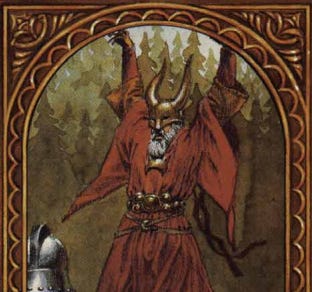
In order for a region of land to be counted as part of a regent’s domain, it must first be formally claimed by rite of investiture. A priest-regent can invest himself or another regent as ruler of up to one 6-mile hex at a time by expending 100 DP and making a successful magic research throw as an ancillary activity. When this throw is made, a rival creature lairing within the hex may pit its will against the claimant’s if it has HD equal or greater than either the priest-investor or the claimant; only the highest HD creature that attempts to do so will be able. When this happens, it imposes its HD as a penalty to the investiture throw, and on a natural 1 or failure by 14 or more, it wrests control of the rite and is itself invested as ruler, stealing half of the would-be regent’s Regency Points, rounded down (if any). Left to its own devices, such a monster could become a Lord of Shadow . . .
Consecration
See the ACKS II Revised Rulebook section on “Using Divine Power” for rules on returning DP through prayer or using it to consecrate altars, fields, and rulers.
Lairs of Power
A spellcaster who attunes a dungeon-sanctum containing a place of power can draw Arcane Power (AP) from it, at the following rates based on the area of the place of power and its magnitude:
Minor Place of Power: 1 AP per 1000 square feet per day
Major Place of Power: 1 AP per 500 square feet per day
Supreme Place of Power: 1 AP per 100 square feet per day
A non-blooded sovereign is only able to draw power from a region of up to 10,000 square feet. An arcanist-regent, however, has a deeper tie to the land and locale, and can collect AP from a place of power of any size so long as it is entirely within his attuned dungeon. This AP is in addition to any he collects from sovereignty over the monsters within such a dungeon.
Additionally, an arcanist-regent has metaphysical authority over the denizens of his dungeon. Whenever he would gain corruption within his dungeon, he may instead transfer it to a creature lairing within, which takes twice as much corruption. Each creature in his dungeon may only be used in this manner once each month, and counts it a calamity each time it acquires a corrupting weakness in such a fashion.
Lastly, the regent can anchor his perpetual spells within the attuned place of power, so that it sustains them as well. He can anchor a number of spells of each level equal to 1 + his WIL modifier (minimum 1), though minor places of power permit only spells of up to 2nd level, and major places of power permit only spells of up to 4th level. Once anchored, they are sustained by the place of power itself — and thus, will persist even if the regent abandons them, so long as their target remains within the place of power, even should the regent die.
Ley Lines
An arcanist-regent who wishes to draw upon his dungeon while not personally present at its site may do so by forging a ley line from the dungeon to his location. The base cost of this research project is based on the distance traversed: 1000gp x [6-mile hexes the ley line will traverse]2, plus 1gp per square foot of the destination site within which he will be able to draw upon its power. It requires paying the base cost in both special components (typically AP) and labor, but not material costs; as part of paying the labor cost, the scion must walk on foot from the dungeon to the final endpoint of the desired ley line. At its attempted completion, the scion must make a successful magic research throw at a penalty equal to the number of hexes traversed. Afterwards, each ley line costs 1 RP per month to maintain, but time spent within its locus destination counts as time spent within the dungeon for purposes of maintaining attunement. If the dungeon it draws from contains an attuned place of power, the ley line gains the associated effects discussed on the ACKS II JJ p. 92, and the locus destination takes on the same properties as the origin place of power (but their area does not increase the AP the regent can extract).
Invested Items
An arcanist or priest regent of any level can create invested items, anchoring them to his power and authority so that they function as magic items while within his realm. This follows the standard rules for crafting magic items on RR p. 391, but the component and labor cost of the research is reduced to 10% of the normal amount. However, at the end of each month, this component cost must be paid again in AP or DP, or else the item’s power dissipates and it becomes a mundane item of its type. In that form it may be used to pay the material cost of recreating the item, but the labor and component costs and any required magic research throw must be wrought anew.
Designer’s Note: Based on the rules for automatons in BTA, a 90% reduction in material or labor cost for a project can be gained by adding a monthly expense of 140% base cost / 33. Reducing both by 90% would thus incur monthly expenses equal to ~8.5% of the automaton’s base cost. I have rounded this up to 10% for convenience and to keep this potent option from becoming overpowered — it is chiefly a way for low level rulers to create some custom items quickly and easily at longer term costs, or for a more powerful ruler to churn out potions and other items that will soon be consumed for use in the defense of his realm.
Supernatural Companions
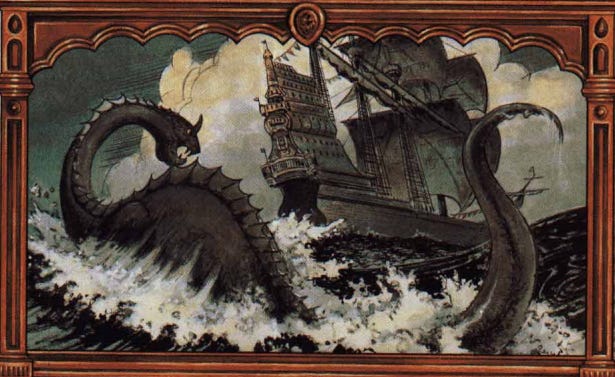
A regent might wish to retain the service of supernatural creatures, such as dragons, demons, faeries, the undead, or even a unicorn steed. The MM provides a “trained value” entry for each, as an estimate of what it might cost to buy their services indefinitely, but for many of these creatures it is implausible to simply purchase one; even if one can enslave a dragon, how does one make it serve? To convert this value into a wage, the simple solution is to divide by 33. I would further propose that many such entities would accept payment in AP or DP, to add another useful function to those resources. A county of 900 families (780 peasant plus 120 urban) generates some 2160 DP per month, sufficient to entice the service of a specter, unicorn, a 6 HD dragon or cacodemon, a pair of invisible stalkers, or eight monstrous attercops — a fitting entourage of wonders or horrors for a 7th-8th level regent, who need not be a caster to benefit.
My rules for summoning monsters as a supreme magic research option are also potentially applicable, particularly when taken with an eldritch bent.
Future Plans
I have often been asked about what is left to finish out this series, and as things presently stand, the only major outstanding element I have planned is rules for awnsheglien and Lords of Shadow, and for bloodtheft. Those will compose the final post in the series, though probably not for a couple months yet — I have quite a bit of travel coming up for various reasons, and such posts are content-dense. A good chunk of that is already drafted, but I want to give it a thorough review in light of II since it is now a couple of years out of date.
In the meanwhile, perhaps as a simpler tack, I think there is a lot of benefit to be offered in providing a gazetteer and basic overview of the setting creation process from the Judges Journal over a series of posts, as a worked example to help illustrate how that plays out. My initial thought was to choose another region of the Auran Empire, perhaps Nicea, which seems to get little attention and could benefit from fleshing out. That said, I have a broad appreciation of the Auran Empire, and don’t feel particularly bound to anywhere in particular, so it seems worth asking: what region would you all find most interesting to see fleshed out for adventuring?
I would like it to be fairly traditional in general parameters, that is, not the unsettled and cityless expanse of the western steppes, nor the isles about Corcano, nor the regions Archon has already covered, but that still leaves pretty much all the known world and a lot of fun regions that I know others have started to delve into. Rorn and Jutland have certainly been popular, and I’m aware of other Judges working on games set in Krysea, Kemesh, and Celdorea. It is a credit to the setting that it holds such broad appeal and potential breadth of campaigns while retaining coherence, and I think that too will come through even more as more regions are built out in the public eye.