
The Stormlord's Citadel
A Flying Fortress Lair for Levels 9-11

Commodore from the ACKS and CAG Discords has organized the third iteration of his Adventure Site Contest, which has had excellent results in the past, which he has made freely available for general use. Lipply’s Tavern and Tower in the Lake in particular I found to be outstanding, and look forward to working my way through most of the list as concise sites to stock and fill up hexcrawls.
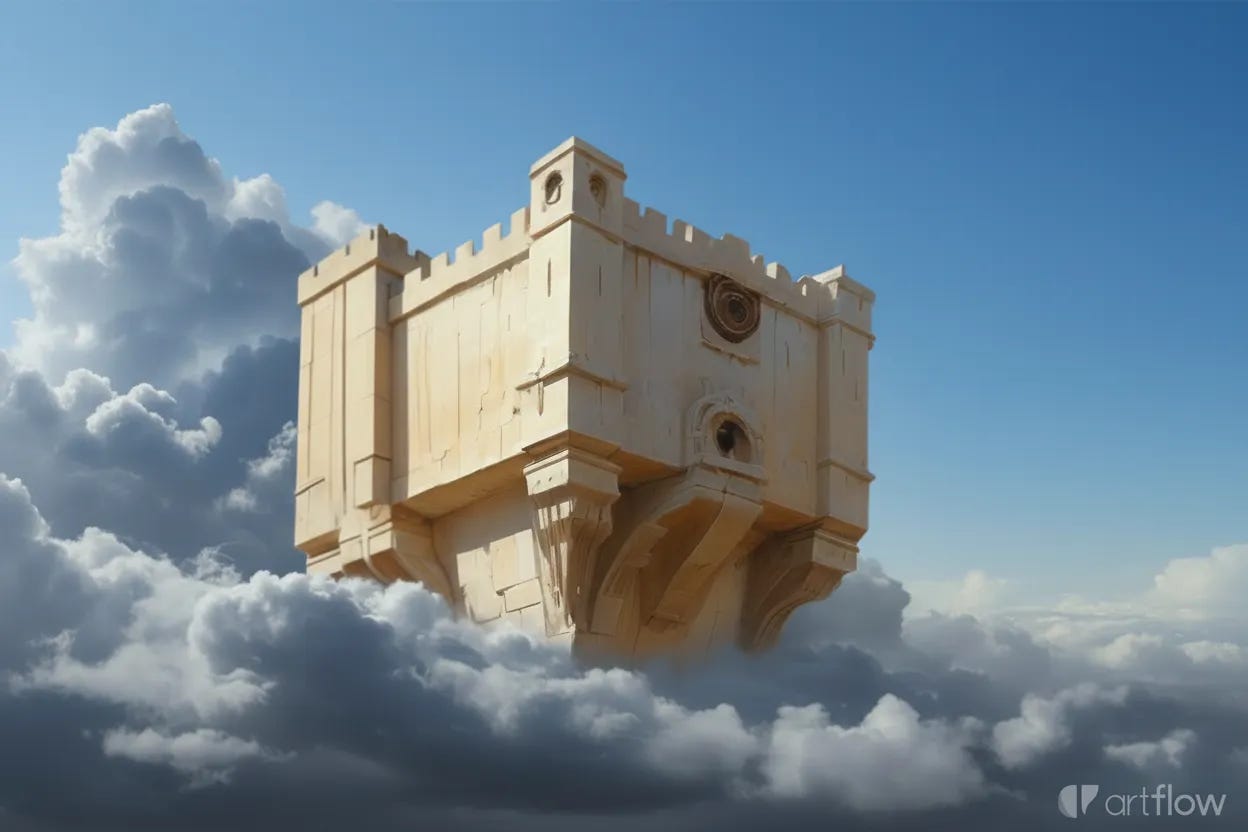
So this year, I put together my own submission, The Stormlord’s Citadel. I would like to publish a couple other projects this year, and the review-and-feedback-heavy format here seems well suited to an initial effort so that later works can benefit from early mistakes. I quite enjoy giants as adversaries; the G-series was my initial introduction to D&D and a formative experience. Cloud castles are of course a classic staple of fantasy, but too involved to run on the fly, so detailing out a storm giant’s home in the clouds seemed a natural choice.
I had not planned to release the project itself until after the competition was over and I had the chance to update it in response to the aforementioned feedback, but there are a whole bunch of contest judges valiantly reviewing every single submission on their blogs and such posts are rather more fun to read when you can pull up the product and directly compare to what they’re talking about. To that end:

If that doesn’t work, it can also be downloaded from Google Drive.
Design Commentary
I expect revision may take it in excess of the competition’s two page limit, though I will aim to stay within three pages. There are some aspects of the scenario that I expect experienced ACKS will grasp with a thorough read but which I would have liked to explain in greater detail . . . which seems an excellent impetus to explain them here instead.
The first major point I would draw attention to is the difference between effective bombardment range (1800’, as per heavy trebuchets) and the Citadel’s standard cruising altitude of 15,000’. At a 24 mile (per 8 hours) expedition speed, it takes the Citadel a full hour to descend roughly 3 miles for siege assault, and as long again to rise afterward. Once within that range, of course, it can eliminate enemy artillery virtually unopposed, being mobile and invisible behind heavy cloud cover while high HD attackers roll boulders over the sides toward static targets (+1 to hit for subjacency, -2 for crude ammunition, and -4 for an unseen target still yields a net attack throw of 8+ for an 8 HD monster, two points better than veteran soldiers).
The second major point I would raise is the extreme difficulty of operating at 15,000’ elevation. A flight spell will be sufficient to ascend in probably three to four turns depending on encumbrance, but likely won’t last long enough to also make it back down. Flying mounts are a more viable option, but anything approaching the Citadel while it drifts 3000’ above the highest obscuring clouds will quickly be spotted and then face a barrage of lightning as it approaches — a risky proposition considering the typical fragility and enormous expense of such mounts. Solutions are well within reach of high level adventurers, but they won’t be trivial. Once within that lofty realm, characters will take mounting penalties from altitude sickness, forcing a hasty resolution or departure.
Taken together, these suggest an alternative route: attacking the Citadel while it besieges some town, once it has descended to much more accessible elevation. This introduces a different issue, namely of finding the Citadel in the midst of its enveloping storm, and replaces the passive time pressure of altitude sickness with the active time pressure of the Citadel’s renewed ascent and ongoing destruction of a probably-friendly settlement. (Which of course can itself be dealt with, if they find the seat of power and displace the Stormlord therefrom.)
In addition to those immediate sources of pressure to keep individual assaults quick, the ability of the Citadel itself to move across the map and attack towns and cities (on its own, or in a combined arms operation with a ground army that has hired it), makes it a potent threat to a ruler’s dominion and one that demands an adventurous solution.
A third point to note is the openness of the central courtyard: it is terribly exposed, and any conflict there is liable to draw in the animate statues from the second story and the upper wallwalk, who can throw thunderbolts from their vantage points above while statues lower down pin adventurers in place, along with the water elemental. Since it is outdoors, the Stormlord can also call down lightning strikes every round. I would have liked to have also given him dispel magic to counter prepared buffs (particularly energy invulnerability) without needing to close with them himself (to deploy his Ring of Antimagic), so perhaps I’ll work that in.
To mitigate the scouting abilities of high level adventurers, the Invisible Stalker that slinks around and watches to raise the alert is one important counter, and the impressive senses of the Quicksilver Golem and the Stormlord himself are another. Invisible intruders will find it difficult to remain undetected, and key rooms are lined with lead to screen against magical observation.
In terms of treasure, a sizable proportion of the potential haul is in the giant-sized workshop, which is quite bulky, and in possession of the Citadel itself (which I estimated as a 4.5Mgp stronghold). Both of these are of course liable to be destroyed if the Stormlord is slain, and thus they reward adventurers who do their research to be aware of that and then handle the situation with finesse to ensure he lives in impotence, or at least to crash it from a low altitude.
As a more minor note, I would be curious whether little details come through, like that the servants are mute because their tongues have been cut out. I should also mark the kitchen and servants’ quarters as lit, and perhaps describe them as carrying candles. I originally had lighting shown on the map but it didn’t look great and it seems to have slipped through the cracks in editing.
Considering potential revisions, I would like to add some minor extra bit of detail to the leftmost caverns on the bottom floor. The cavern map in general might benefit from another pass. Labelling the maps with their floor number would also probably be beneficial; for a smaller site like this, I have not made up my mind on whether rooms should be numbered in one sequence or separately by floor. I’m also undecided at this point whether it might be worthwhile to redo it entirely in a simpler, cleaner format. Dungeondraft is good for making maps suitable for VTTs, but that’s not really a use case I particularly care about. However, neither are my hand-drawn maps paragons of clarity, so it’ll take some experimentation to find a good candidate.
First Feedback
. . . And, before I had the chance to finalize my thoughts above, Grutzi has already beat me to it and shared his own review. It is good to hear he enjoyed the detail of the map, and the criticism that it makes it potentially hard to read is very fair. The map size is a bit of a funny story — I have made Dungeondraft maps for my own use on a few occasions, but this is the first time I’ve printed them to images for sharing, and the initial print on default settings grossed roughly 100MB (apparently calibrated for VTT displays). I adjusted the settings after that to get files small enough to send in an email, but figured, “it’s a titan’s castle, why shouldn’t the maps be gigantic?”
Refining the prose descriptions is a good critique that I will have to put some thought into. To answer some specific questions he poses that I’ll have to incorporate into the text:
The statues can jump down with normal fall damage, but probably won’t, because their primary attacks are to fling thunderbolts and they have sufficient range to hit anywhere in the courtyard.
Walls are sheer surfaces and can be scaled by thieves and similar classes at normal rates.
The mirages hold from both sides and depict natural formations of alabaster that match with the rest of the Citadel.
I am hopeful that other judges will have similarly practical feedback! It is a significant draw of the competition, which I am told has totaled some 40 entries this time round. From what I’ve seen thus far, there’s some stiff competition, and the sites have been uniformly well worth reading through and prepping to add into a hexcrawl.