
Lords of Shadow
Fantastic Beasts and How to Kill Them

From initial framing for ACKS Birthright and general rules, to bloodline powers, to rulership, to realm magic, to additional magical options for regents, I’ve discussed adapting most major aspects of Birthright outside the details of the setting itself. Many such details are awesome, but hard to generalize; one of the most important, however, is the rules for conflict between blooded powers (above and beyond what is directly afforded rulers through campaign activities and the normal ACKS rules). These focus on two key mechanics: bloodtheft (by which means one might strengthen one’s bloodline at the cost of anothers), and awnsheglien (which I have taken to calling “Lords of Shadow”).
Inheritance
Before discussing bloodtheft and the usurpation of bloodlines, however, it first must be addressed how they are normally inherited. ACKS does not have an explicit system for attribute inheritance yet (more properly, it has an unofficial one in an Axioms article, which I don’t find particularly compelling, and it has some forthcoming principles for elves in Before All Others). The system I have used is that when a child rolls attributes, it takes a random die from its father and from its mother, and then rolls a third die, to generate stats on 3d6 down the line. If it is desired to roll stats on 5d6 or 4d6 keeping the best three, then after rolling the three dice, the player can make an appropriate number of rerolls. For BLD, if only one parent was blooded, the other parent always contributes a die roll of 0.
Bloodline derivation is inherited from a blooded parent. If both parents were blooded, there is a 1 in 6 chance the child inherits the derivation from the stronger bloodline (whichever it may be), or else inherits the derivation of the parent of the same sex (i.e. a son generally inherits his father’s bloodline, while a daughter typically inherits her mother’s). (Those wishing to hew more closely to the original Birthright rules can simply reverse those chances.)
Whenever a scion would gain a bloodline power, there is a 4 in 6 chance they gain the same power their parent of the same derivation gained at that level or tier of bloodline potency. If the parent’s powers are unknown, the powers can simply be rolled normally, but in cases where a parent’s bloodline abilities are concretely established, their children of the same derivation will tend to match them.
When a scion dies, his heir (if any) immediately inherits his domain without needing a Ceremony of Investiture, and gains his current Regency Points, unless bloodtheft interferes.
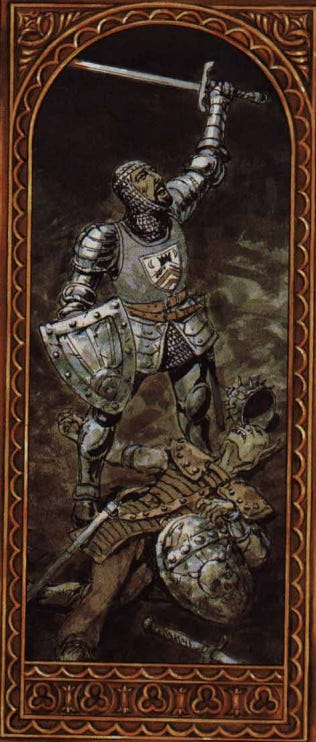
Bloodtheft
The scions of the blood of old carry great power within them, and none who lacks their divine graces might harm it. But those who share in their power can take it, the theft and usurpation of a bloodline, known as bloodtheft. This requires a blooded scion to slay another with a blow that pierces the heart: he must be wielding a piercing weapon and deliver a coup de grace. Upon successfully doing so, the usurper instantly is considered to be the heir of the one he slew, inheriting his domain and current Regency Points without needing a Ceremony of Investiture (getting that claim recognized by men may be more difficult, and will likely require force of arms).
If the BLD attribute score of the slain scion was greater than that of the blooded usurper, the usurper permanently increases his BLD score by one point.
Tighmaevril
Weapons wrought of tighmaevril are not merely capable of stealing bloodlines but yearn for it. “Blood-silver” blades will instantly slay any blooded scion they reduce to 0 hp or below and grant the full benefits of bloodtheft above, even to an unblooded wielder.
Additionally, if the usurper would qualify to increase his BLD score via bloodtheft with a tighmaevril blade, instead of increasing his BLD score by one point he may choose to permanently raise it to match that of the slain scion. If he does so and his BLD attribute bonus increases, he must save vs Death, at a penalty equal to the difference between the usurper’s and victim’s level or HD. On a success, he may steal one bloodline power from the victim, permanently gaining that power in lieu of whatever power he would be entitled to from increasing his BLD attribute. On a failure, he suffers bloodtaint, and his bloodline derivation is permanently converted to match that of the slain; he immediately assumes the bloodline powers of the slain to the extent possible, replacing his own powers as appropriate. An unblooded usurper always assumes the bloodline derivation of the slain.
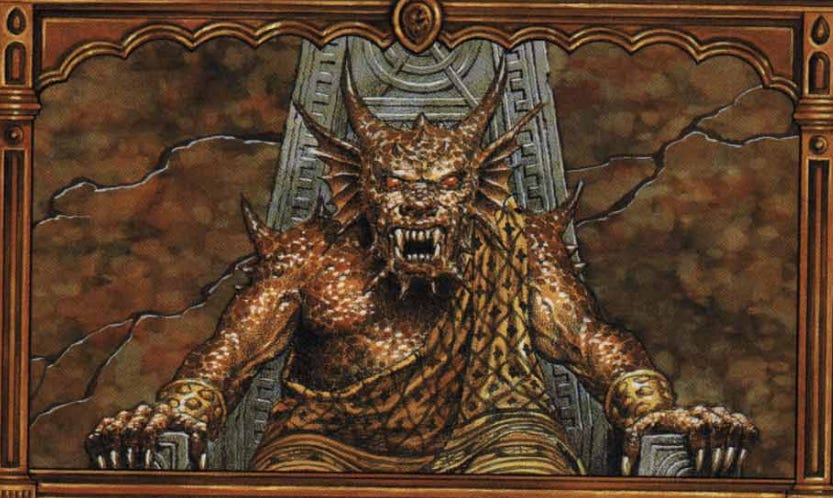
Lords of Shadow
The awnsheglien or Lords of Shadow are Birthright’s great antagonists: Blooded monsters of Azrai’s derivation. Terrain encounters with a Monstrous Shadow should be replaced with Lords of Shadow, though the Judge may use such Lords as Chaotic rulers as well. Lords of Shadow are typically paragons of some natural animal or Chaotic monstrosity.
Compared to a normal monster of its type, a Lord of Shadow will take the higher of either increasing its HD to a minimum of 11, or increasing them by half (to a maximum of 36). Per HD of increase, its average damage increases by 2 and its AC increases by 1. For every 4 HD of increase, it gains one special ability as a cacodemon, and because of its bloodline should be considered to have a further * for purposes of XP and treasure. Its size category generally increases by one, to a minimum of at least Large. All Lords of Shadow are of Chaotic alignment and sapient intelligence.
Lords of Shadow will have BLD attribute scores rolled on 4d6, keeping the best three dice, with a minimum result of 9. Particularly ancient or powerful Lords may be assigned better rolls or higher scores by the Judge, even up to BLD attribute scores exceeding 18: 19-20 is a True Bloodline with a +4 bonus, 21-23 is a Pure Bloodline with a +5 bonus, and a score of 24 is a Deific Bloodline with a +6 bonus. They possess one bloodline power, plus one per point of BLD bonus, plus an additional power at 5 HD, 9 HD, 13 HD, 17 HD, 21 HD, 25 HD, 29 HD, 33 HD, and 36 HD, as normal for scions. Lords of Shadow always follow Azrai’s bloodline derivation or equivalent, though they can potentially possess the bloodline powers of other derivations.
A Lord of Shadow will have a domain of at least one 6-mile hex, all of which will be a shadowed sinkhole of evil (equivalent to a place of death). Its stronghold-lair within that domain will be a blighted sinkhole of evil (equivalent to the prior place of death overlapping a Chaotic altar). If the domain is not occupied by beastmen minions, enslaved humans, or other families, the Lord of Shadow gains access to a Chaos Holding of rank equal to its HD, of which the Lord is a beneficiary. (This is specifically to compensate for a Lord which does not rule a traditional domain — it likely still has some manner of monstrous servitors!)
A scion who reduces a Lord of Shadow to 0 hp or below must immediately make a save vs Death, at a penalty equal to the difference between the scion’s and the Lord’s HD. On a success, the Lord has been truly vanquished and its bloodline purified; the scion benefits as though he slew the Lord via bloodtheft. On a failure, he gains the same benefit but suffers bloodtaint: the scion’s own bloodline is corrupted and permanently converted to Azrai’s derivation, and he assumes the bloodline powers of the slain Lord to the extent possible. Moreover, he becomes tainted by the Shadow itself, and will slowly transform into a Lord of Shadow himself. This normally takes a number of days equal to the square of the scion’s level or HD, but is accelerated by one day any time the scion benefits from a bloodline power of Azrai’s derivation. A remove curse spell causes the day on which it was cast to not count against this decay.
The Shadowlands
The custom setting I have developed for playtesting ACKS-Birthright was designed to embrace the conqueror gameplay loop and adventurous warfare between regents, being a land held firm within the tyrannical grip of the Lords of Shadow and their blooded minions.
Thus the legends tell us: A century ago, the hosts of the Shadow marched against Creation, their armies beyond number and their power beyond reckoning. The Elders had failed in their warding, and the Makers in their keeping, but on the eve of world’s ending the strength of men was not yet spent, and their heroes sallied forth with their very gods beside them. And still, the Shadow triumphed: the Light was broken, its champions scattered, its gods slain upon the Field of Tears and all the world cast into eternal twilight. Only a remnant escaped the desolation, and fled into the mountains, and bore the last hope of dying Light within them. Now a century has passed, and even that hope falters feeble, as deathless legions stand relentless before mountain-gates and the Shadow’s dark designs near their final conclusion. But the Shadow has erred: the power long dormant within exiled souls has been rekindled, and those in whom it burns may yet turn away the final night, if it does not consume them.
From mountain-refuge, blooded heroes arise once more, and if they have the strength they may yet push back the Shadow, reclaiming the lands veiled in darkness as their own realms and slaying the dark gods who now rule there.
It is more black-and-white than the original Birthright, by design, to fully embrace typical epic fantasy themes and to broadly align PCs as paragons of Law with endless Chaos to war against. I think Birthright mechanics are quite well suited to that, and I think as well that the base ACKS gameplay loop would work impressively well in a “rebels against the evil empire” sort of setup, while also presenting a variety of novel challenges.
Sadly, my group that I had begun playtesting things with encountered manifold scheduling issues, so I have not run things through, but someday I will be able to run that campaign. When I do, I expect that will lead to some further clarification, expansion, and revision, and ultimately to refine these rules to a place they are worth publishing. In the meanwhile, let me know if you make use of them!