
Why Not NPC Classes?
Also: the Sage

After all, why not? Why shouldn’t I make an NPC-only class?
This question came up on the ACKS Discord some time back in the context of sages, and is one I have reflected on since, and the answer really comes down to the sort of game we’re playing. In 3e D&D, I don’t think it’s fundamentally a problem. It is well suited to that mechanical framework, where skills advance with level and there’s no presupposition of symmetry between PCs and NPCs.
NPC classes generally arise in such contexts from the conception that PC classes are fit for special people of great power and significance, and that NPC classes are distinct in that they focus on “unspecial”, more mundane talents less suited to adventure or authority. Sages, craftsmen, merchants, and the like all might fall into such a category, where mechanically they require certain abilities at a given level of competence that requires levels, but they don’t need the corresponding martial prowess, and generally aren’t the sort of special people who would advance into PC classes anyway. This in turn reflects an assumption that heroic stature and personal power are fundamentally distinct quantities from one’s stature in ordinary society.
In ACKS, a very different approach is taken. A typical NPC ruler is a fighter, just like a many PCs; the difference between PC and NPC is much narrower, more a matter of willingness to dare and take risks than a matter of mechanical distinction. This arises from what levels and XP represent: the accrual of glory and spiritual power through the exercise of heroic authority. A ruler is powerful because rule is glorious. This reflects traditional Western fantasy, from history to pulp: the great aristocrats of Homer, Tolkien, and Burroughs can be assumed to be great heroes, by simple virtue of their station. Creating levelled characters who are not capable of adventure and rule and power is undermining the essence of what levelled characters are, in such a framework.
So, what about those sages, craftsmen, and merchants? That same tradition answers that they, too, are powerful. Elrond, Feanor, Hephestus, Daedalus, Archimedes, Dido, Merlin, Wayland, Sinbad, Marco Polo . . .
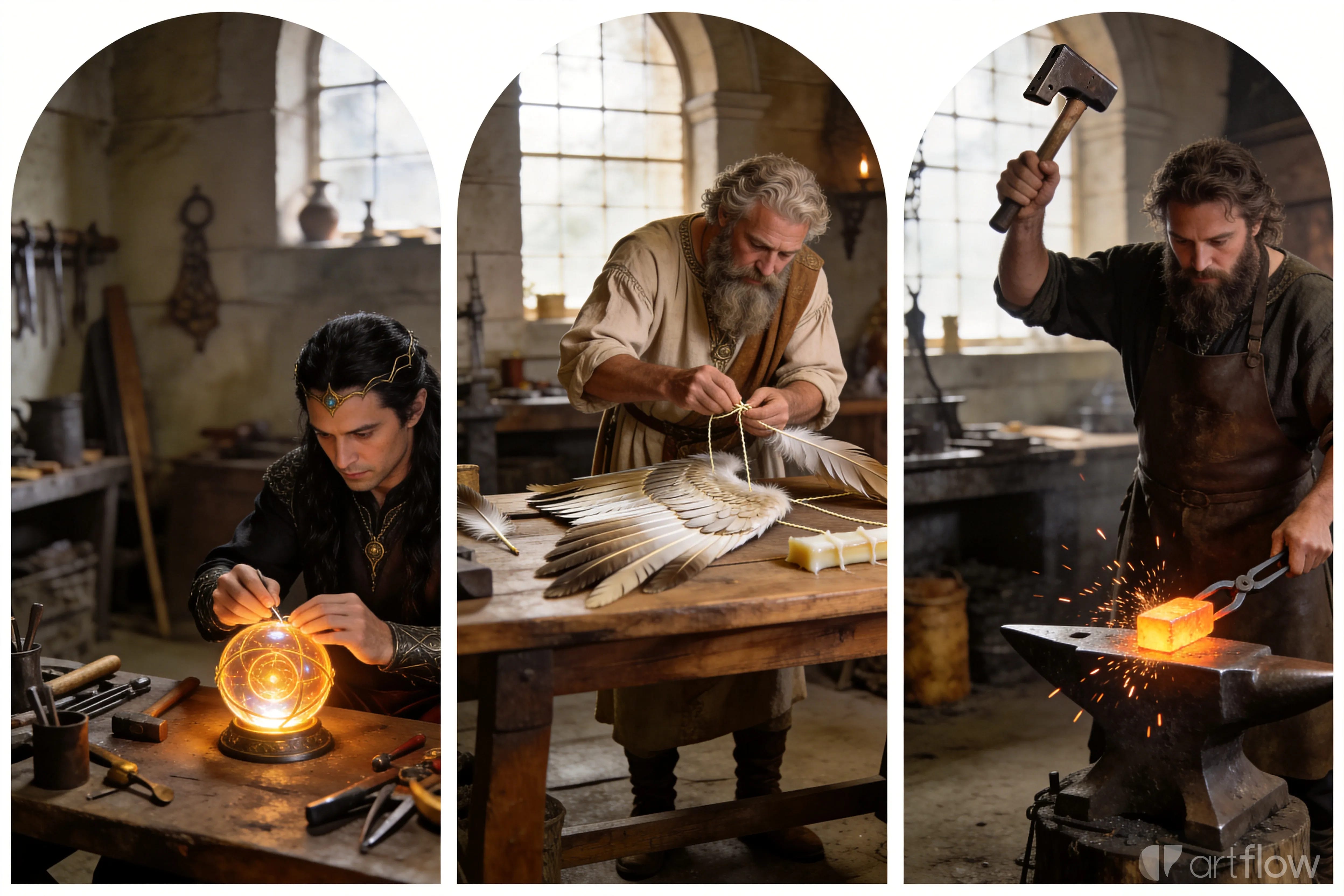
If there is a need for unimportant artisans in such a framework, 0th level characters can take proficiencies and attain great skill. But if a class is to be made for them, the point of having such a class is to elevate such characters to personal and social power.
I would further note that ACKS compellingly demonstrates that opening such options to PCs has pretty much uniformly good effects. A “merchant” class for NPC sellers of goods is simply much lamer than the existing venturer class open to PCs! Item crafting and advanced magic research likewise! PCs don’t need to engage, but they have the option to. So I see no reason to expect that advanced lore skills or virtually anything else should be different. Denying cool options to PCs is easier but not more rewarding.
(As an aside, taking easy options can certainly be justified in terms of getting something playable, but at the point you’re making a new class, that’s a wholly optional additional workload that’s worth taking the time to do in the best possible way that can be found, or not at all.)
A couple of counterarguments worth discussing: the Axioms rules for Noncombatants, and classes like the forthcoming Elven Arborist in BAO.
It is true that Axioms introduces rules for Noncombatant characters; frankly, I don’t think they’re a great fit for ACKS, but they’re a tool for tuning the game to your interests. If someone much prefers the sort of setting where PCs are inherently distinct from NPCs, and authority does not bear a crown of might, the Noncombatant rules are a way to convert it to better match that.
The forthcoming Elven Arborist is a more nuanced circumstance, more comparable to the Venturer. It’s not a class optimally suited to dungeoneering, but both still have applicable features that are quite handy (especially Treachery, Natural Medicine), have specialties that do come up, and when push comes to shove have a solid baseline as capable combatants (short bows and polearms for the Arborist!). And for the right sort of gameplay (arbitrage, sylvan exploration), each offers impressive advantages. They’re not NPC classes, they just have clear niches.
Which brings us to the Sage, considering the appropriate build for which originally inspired this article.
Sage
Key Attributes: INT
Requirements: None
HD: d4
Max Level: 14
XP to 2nd Level: 2375
Sages are scholars and loremasters, well-learned in arcane lore, though not so masterfully as mages. Rather, they supplement sorcery with deep knowledge, and the capacity to acquire yet more by drawing together the most relevant pieces of a research library to grasp the grander picture.
Combat Proficiencies: Sages have weapon proficiency with clubs, daggers, slings, and whips. They have no armor proficiency. They have fighting style proficiency with no optional styles.
Combat Progression: Sages advance in attack throws by two points every four levels of experience (i.e., as thieves), but in saving throws at only two points every six levels (i.e. as mages). They do not gain any bonus to damage as they advance in level. They can cleave after killing a foe a maximum of once per round per every two class levels (rounded down).
Starting Class Powers
At the start of play, sages have the following class powers: Collegiate Wizardry, Deciphering, Esoteric Research, Knowledge (any), Magical Engineering, and Study of Lore. Additionally, sages cast Arcane Magic using the Arcane 3 progression given on JJ p295 (starting at 1st level as a 1st level mage; at 2nd-8th level, as a mage of one level lower than themselves; at 9th-12th level, as a mage of two levels lower; at 13th-14th level, as a mage of three levels lower). It is strongly recommended that sages be granted the full research rate of mages of their level.
Esoteric Research: A sage is capable of esoteric research that bridges disciplines across dozens of tomes and scrolls in a research library, illuminating hidden insights that surpass the scope and depth available to readers of lesser mastery. When confronted with a specific topic outside his chosen Knowledge specialty, he can conduct research as an ongoing dedicated activity in a research library worth at least 30,000gp and taking 1d8 days per 30,000gp of value (counting the library’s total value the researcher takes advantage of access to, not divided by the number of readers; minimum one dedicated activity). He may attempt to finish more quickly, but takes a -1 penalty per day short of the rolled period. If he has at least two ranks in Knowledge, the time required decreases to 1d6 days per increment, or 1d4 days with three ranks in Knowledge.
Upon completing this research, he can make a Loremastery throw, with a +1 bonus for every additional 30,000gp of research value of the library consulted. On a success, he can recall expert commentary as if he had succeeded on a relevant Knowledge proficiency throw.
Additionally, by examining old histories in a research library, the sage can perform Treasure Hunting hijinks using his Loremastery throw in lieu of Searching (and without needing Streetwise proficiency). He gains bonuses from possessing other proficiencies as normal, as well as adding his library bonus to magic research. For every -1 penalty he takes to this throw, he can attempt to find a map to a treasure worth an additional 1d6 x 1000gp. If “caught”, the Judge will secretly roll 1d6 to determine the consequences: 1-3, must lie low or reroll on 1d3+3; 4-5, a rival adventuring party starts surveilling him to snatch his next target; 6, a rival adventuring party starts trying to kidnap or kill him to secure his research. Determine the level of the rival adventuring party from a base level of 8 - [local settlement’s market class].
Study of Lore: A sage’s deep study of lost wisdom grants him benefits as Loremastery proficiency. However, if he also takes Loremastery proficiency, he gains a +2 bonus to Loremastery throws, his eligibility to undertake Major Magic Research is determined as if he were two caster levels higher than actual, and he can count a research library as a research workshop of half its value.

Additional Class Powers
When they advance in level, sages gain the following additional class powers: at 3rd level, they gain a second rank of Magical Engineering; at 5th level, they gain a third rank of Magical Engineering; at 6th level, they gain Minor Magical Research; at 9th level, they gain the ability to Unveil Esoteric Meaning and can found a Sanctum; at 11th level, sages can undertake Major Magic Research; at 11th level, sages unlock the Wisdom of the Ages (since this class is designed for non-eldritch campaigns by default, this power additionally grants a +1 bonus to saving throws); at 14th level, sages gain access to Supreme Magical Research.
Class Proficiencies
Proficiency Progression: At 1st level, sages select one class proficiency from their class proficiency list and one general proficiency from the general proficiency list. They select an additional class proficiency at 6th and 12th level. They select an additional general proficiency at 5th, 9th, and 13th level.
Sage Proficiency List: Alchemy, Armor Training, Bargaining, Battle Magic, Beast Friendship, Black Lore of Zahar, Bright Lore of Aura, Counterspelling, Elementalism, Elven Bloodline, Engineering, Expanded Repertoire, Experimenting, Familiar, Illusion Resistance, Knowledge, Language, Loremastery, Martial Training, Mastery of Enchantments & Illusions, Mastery of Conjuration & Summoning, Mystic Aura, Quiet Magic, Prophecy, Sensing Power, Soothsaying, Transmogrification, Unflappable Casting
Secrets
The Sage is built as F1a/A3, yielding a cost of 2375 XP to 2nd level. Armor is traded from Broad to Restricted for four powers, weapons are traded from Narrow to Restricted for another, and both fighting style proficiencies are traded away for an additional two powers. This results in a total of seven class powers plus a free general proficiency.
Two powers at 1st are traded off for powers at 3rd and 11th and at 5th and 9th. One power is spent to gain Deciphering, which is listed as a thief skill but can be taken as a class power (a la Climbing and Eavesdropping) following the precedent set by the Loremaster (from the HFH).
Design Commentary
A typical Sage hireling is a 5th level Sage, as might be inferred from their wage (500gp being enough to support a lifestyle as a 5th level character but not one of 6th level), who has spent their general proficiencies at 1st and 5th on additional ranks of Knowledge. The RR lists their throw to recall expert commentary or identify magic items as 3+, which matches this build (Knowledge III, Magical Engineering III). The 18+ throw given for Loremastery improves to 14+ (which I think is reasonable; the poor chance of even a sage succeeding on Loremastery has been remarked on). The JJ indicates an 8+ throw for a Sage to identify an item by magic research, which matches their 12+ base throw with +3 from Magical Engineering and an expected +1 INT (the average bonus for a prime requisite rolled on 3d6). The numbers check out.
The Esoteric Research power also creates a framework for addressing why sages might take a considerable amount of time to answer a question, and why they have broad ability to do so and not merely expertise within a very narrow field. In the default case, a Sage with Knowledge III and a 14+ Loremastery throw in a Class III market will take a full month to max out their bonus to 2+ to be able to find the answer to an unusual query in a dusty tome.
In terms of “would a PC want to play this?”, being approximately one level behind on spellcasting is certainly a major downside compared to a mage. The comparative upsides include gaining a whole bunch of class powers that give sages more information context, excellent item identification, a modest edge in magic research, interesting alternative downtime options when they don’t have money to burn, and a better attack progression — all for a slightly lower XP cost.
Incidentally, this class also fits neatly to emulate Gandalf, providing Loremastery, F1 attack progression, martial training to gain access to swords, and the iconic research in the archives of Minas Tirith.
On the whole, I am content with where it stands, and while I don’t expect it to be as popular as a mage, I do think the occasional PC would give it a try (which is in itself appropriate; mages should be the most common arcane casting class). More often, I’d expect a PC to take a sage as a henchman, but it is still a class that a PC would want to see advance in level and not just work endlessly around town as a perpetual 1st level.
Such a class also fills a very useful mechanical niche, inasmuch as 0th level sages are going to advance up to 5th level fairly rapidly if they are undertaking magic research to identify items (since they do so as 5th level characters). On the whole then, I think it’s a useful elaboration of the system to show how sages are actually 5th level characters, while opening that same option to PCs who want to try it, which was rather the point of the exercise.
The design logic is deserving of superlatives beyond my vocabulary.
I like it. Better than the Mage, it's got bells and whistles and all. The Mage is boring. Then again, I'm not a caster anyway.